Cashout caps and tier rules
LuckyWave withdrawal limits
LuckyWave Withdrawal Limits: Weekly, Monthly and Tier Rules
 Available in GB
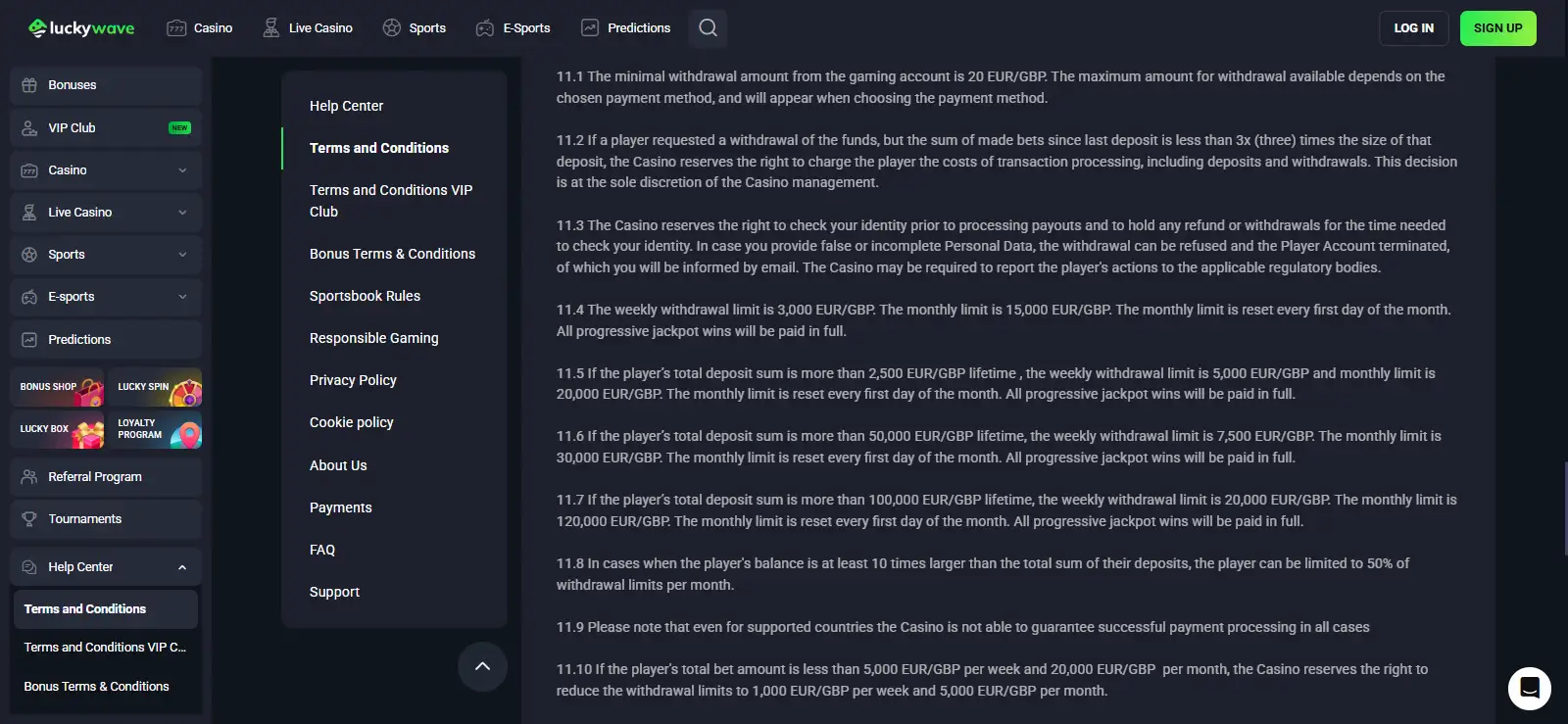
LuckyWave’s current terms set a standard withdrawal cap of £3,000 per week and £15,000 per month. The published caps rise at lifetime-deposit thresholds above £2,500, £50,000 and £100,000, but the same terms also reserve lower limits when stated betting-volume conditions are not met. For a large GBP balance, the important question is not only whether a withdrawal method is available, but how much of the balance can leave the account in each weekly and monthly window.
For the wider casino context before planning a large cashout, start with the LuckyWave UK review; this page focuses only on the contractual withdrawal-cap structure.
Current GBP caps
- LuckyWave’s published weekly and monthly withdrawal tiers
- Two clauses can reduce the practical monthly cashout capacity
- Why a large balance can take several withdrawal windows
- Account caps are not the same as payment-method maximums
- Progressive jackpot wins are carved out in the current limit clauses
- A practical checklist before relying on a LuckyWave cashout limit
- Read weekly, monthly and reduction rules together
- How LuckyWave’s tiered cashout caps affect larger balances
LuckyWave’s published weekly and monthly withdrawal tiers
For a UK-facing GBP account, the standard level is £3,000 per week and £15,000 per month. Higher caps apply once the player’s lifetime deposit total passes the thresholds shown below. These are account-level limits in the terms, not promises that every payment method can process the same amount in one transaction.
| Lifetime deposits | Weekly cap | Monthly cap | Practical reading |
|---|---|---|---|
| Standard level | £3,000 | £15,000 | Baseline published cap unless another term changes the available amount |
| More than £2,500 | £5,000 | £20,000 | Higher weekly and monthly ceiling after the stated lifetime-deposit threshold |
| More than £50,000 | £7,500 | £30,000 | Higher tier for accounts above the second lifetime-deposit threshold |
| More than £100,000 | £20,000 | £120,000 | Highest published tier in the current terms |
The monthly limit resets on the first day of the month under the current clauses. That matters because a weekly cap and a monthly cap can bind at different points. A player can be below the weekly ceiling on an individual request while still having little or no monthly capacity left after earlier withdrawals in the same month.
These tiers should not be read as a reason to deposit more money in order to unlock a larger cashout limit. Lifetime deposits are simply the condition LuckyWave currently uses to define the higher published caps. Depositing extra money creates additional gambling exposure and does not remove other checks, method limits or withdrawal conditions.
Reduction clauses
Two clauses can reduce the practical monthly cashout capacity
LuckyWave’s current terms contain two reduction mechanisms that are easy to miss if the tier table is read on its own. First, when a player’s balance is at least ten times larger than the total sum of deposits, the terms say the player can be limited to 50% of the applicable monthly withdrawal limit. This is a balance-to-deposit rule, so it can matter even when the account otherwise qualifies for a published tier.
Second, the terms reserve the right to reduce withdrawal limits to £1,000 per week and £5,000 per month when the player’s total bet amount is below £5,000 per week and £20,000 per month. The clause does not turn the standard table into a guaranteed minimum. It creates a lower reserved limit under the stated betting-volume thresholds.
That distinction is important for cashout planning. A reader should not look only at the highest tier they appear to meet and assume that amount will necessarily be available as an immediate withdrawal ceiling. The account can also be affected by the reduction clauses and by the maximum shown for the selected payment method.
What can change the usable cap
- The weekly and monthly tier linked to lifetime deposits.
- The 50% monthly reduction clause for a balance at least ten times total deposits.
- The lower £1,000 weekly and £5,000 monthly reserved limits under the stated betting-volume thresholds.
- The maximum available for the chosen withdrawal method.
Cashout planning
Why a large balance can take several withdrawal windows
A useful way to read the terms is to separate the size of a balance from the rate at which it can be withdrawn. Suppose an account is on the standard £3,000 weekly and £15,000 monthly tier and has a £12,000 withdrawable balance. If no reduction clause or payment-method maximum interferes, the weekly cap alone means that balance cannot leave in one request; it would require at least four £3,000 weekly windows.
Now take a £25,000 balance on the tier above £2,500 in lifetime deposits. The published weekly cap is £5,000 and the monthly cap is £20,000. Five weekly £5,000 withdrawals would total £25,000, but the monthly ceiling means the full amount cannot be withdrawn inside one monthly allowance. At least part of the balance would carry into another monthly period if the terms remain unchanged and no other restriction applies.
The same principle becomes more visible at the higher tiers. A £60,000 balance on the £7,500 weekly and £30,000 monthly tier has a monthly ceiling that is four times the weekly cap. Reaching the monthly maximum therefore still requires multiple weekly windows. The £20,000 weekly and £120,000 monthly tier offers much more capacity, but it remains a cap structure rather than an unlimited cashout promise.
These examples are arithmetic illustrations of the published limits, not predictions of how LuckyWave will process a specific account. Identity review, method availability and the contractual reduction clauses can still affect the practical outcome. For process and timing rather than capacity, see the LuckyWave withdrawals guide.
Different limits
Account caps are not the same as payment-method maximums
LuckyWave’s terms say the maximum amount available for withdrawal depends on the selected payment method and is shown when that method is chosen. That creates a second layer beneath the weekly and monthly account caps. An account may have room under its monthly allowance while the selected rail still shows a separate method-specific maximum that governs that request.
This is why the LuckyWave payment methods page and the cashout-limit page answer different questions. The payment page helps identify the available rails and their published processing labels. This page explains the account-level throughput rules that can stretch a large balance across multiple requests or periods.
For practical planning, check the current method screen at the moment of withdrawal instead of assuming the account-level cap is also the per-request maximum. The terms themselves direct the user to the chosen method for that maximum, which means a static article should not invent a method figure that is not visible in the current interface.
Jackpot treatment
Progressive jackpot wins are carved out in the current limit clauses
The current withdrawal-limit clauses state that progressive jackpot wins will be paid in full. That language appears alongside the standard and higher tier provisions, making progressive jackpots a specific exception to the ordinary cap wording. It is still important to distinguish this contractual treatment from the processing route and from any identity checks that may apply before a payout is completed.
A large non-jackpot balance should therefore be planned against the relevant weekly and monthly limits, while a progressive jackpot should be checked against the current jackpot clause itself. Because this is contractual wording, a player with a material balance should re-read the live terms rather than rely on an old saved image or cached limit table.
Before requesting
A practical checklist before relying on a LuckyWave cashout limit
- Identify the lifetime-deposit tier shown by the current terms rather than assuming the standard cap applies.
- Check whether the balance-to-deposit or betting-volume reduction clause could be relevant.
- Confirm the maximum shown for the selected withdrawal method.
- Separate withdrawal capacity from processing time and KYC review.
- For a large balance, map both weekly and monthly ceilings instead of multiplying one weekly number indefinitely.
If the main concern is not the contractual cap but a delayed or pending request, use the withdrawal times and process guide. If the concern is whether other users report recurring payout issues, the separate LuckyWave complaints and reviews page keeps reputation evidence distinct from the operator’s formal terms.
Cap order
Read weekly, monthly and reduction rules together
The tier table is only the starting point for a large-balance calculation. A weekly ceiling controls how much can leave in a shorter window, the monthly ceiling limits the total across that month, and the two published reduction clauses can lower the practical amount even when the account qualifies for a higher lifetime-deposit tier. The selected payment method can then add its own maximum. Reading those layers in that order prevents a higher headline tier from being mistaken for an unconditional per-request entitlement. For planning purposes, the usable figure is the lowest limit that actually applies to the account and chosen method at that moment.
Larger balances
How LuckyWave’s tiered cashout caps affect larger balances
LuckyWave currently publishes a clear four-level GBP cap structure, starting at £3,000 weekly and £15,000 monthly and rising with stated lifetime-deposit thresholds. The practical ceiling can still be lower because the terms include both a balance-to-deposit reduction clause and a betting-volume reduction clause, while each payment method can have its own maximum. Progressive jackpot wins are treated separately in the current terms. For UK readers with a large balance, the safest planning model is therefore to check the live tier, both reduction clauses and the selected payment method before estimating how many withdrawal windows may be needed.
Prepared by the LuckyWave Casino editorial staff.