Current review signals separated from verified operator terms
LuckyWave complaints
LuckyWave Complaints and Reviews: Payout, Support and Self-Exclusion Signals
 Available in GB
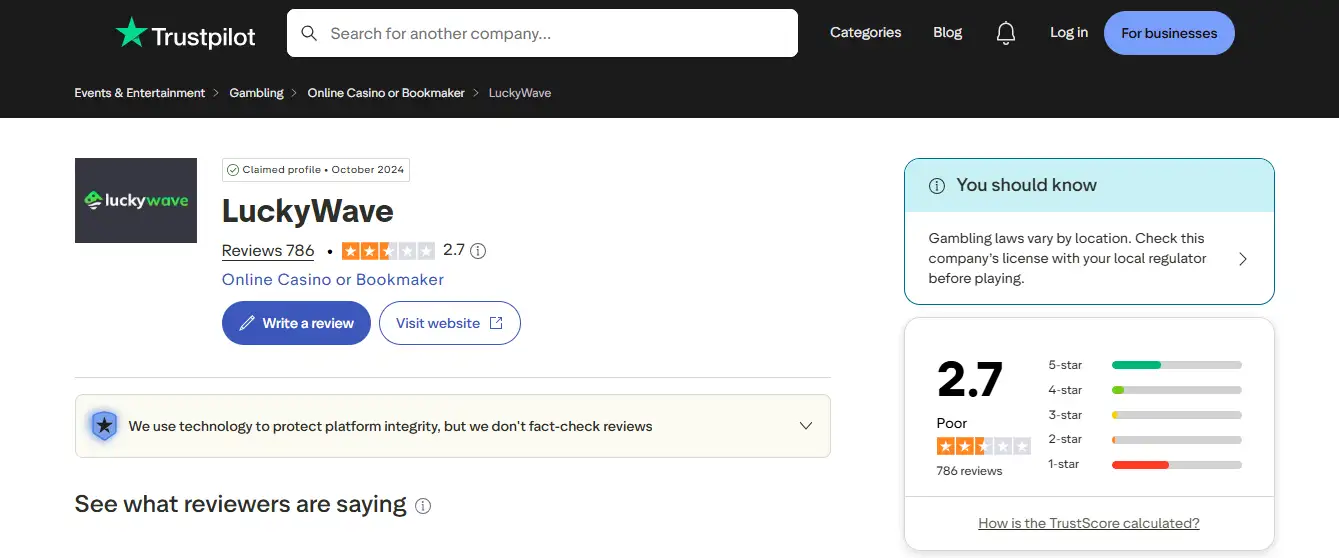
Trustpilot showed LuckyWave at 2.7/5 from 780 reviews in the same-day check on 11 September 2026, with 44% of reviews rated one star and 38% rated five stars. Casino Guru currently gives LuckyWave a 2.5/10 “Very low” Safety Index and shows 17 user reviews. Across the current review material, recurring negative themes include withdrawal delays, account-closure frustration, support dissatisfaction and licence concerns. These are user reports and third-party ratings, not proof that every player will have the same outcome, so they should be compared with LuckyWave’s own published payment, support and responsible-gaming terms.
Same-day snapshot
- The current reputation signals are weak, but they are not one single dataset
- Withdrawal-delay complaints need to be separated from published method times
- Account-closure complaints are particularly relevant when self-exclusion matters to you
- Support complaints coexist with an official 24/7 support claim
- Licence concerns in reviews should be verified against the regulator, not repeated as slogans
- The review profile also contains positive experiences
- How to use LuckyWave reviews before depositing
- What the current LuckyWave complaint pattern should change in your decision
The current reputation signals are weak, but they are not one single dataset
Trustpilot’s LuckyWave profile showed a 2.7/5 rating from 780 reviews at the time of this check. The distribution was polarised: 44% one-star and 38% five-star, with much smaller shares in the middle. Trustpilot also labels the page as a claimed profile and notes that reviews are opinions of individual users. The visible profile says the company replies to a high share of negative reviews, which is useful context when reading the complaint stream rather than treating it as an unmoderated wall of accusations.
Casino Guru uses a different method and should not be treated as the same kind of score. Its current LuckyWave review gives a 2.5/10 Safety Index, labelled “Very low”, and separately shows user feedback and complaint material. Casino Guru says its Safety Index incorporates its assessment of terms, complaints, estimated casino size, blacklists and related factors. It is therefore an editorial risk score, not a regulator finding.
| Source | Current signal | What it measures | Limitation |
|---|---|---|---|
| Trustpilot | 2.7/5, 780 reviews | Aggregate customer-review reputation | User reports are anecdotal and may vary widely by case. |
| Trustpilot distribution | 44% one-star, 38% five-star | Degree of polarisation | Star shares do not verify the facts inside individual reviews. |
| Casino Guru | 2.5/10, Very low Safety Index | Third-party editorial risk assessment | It is Casino Guru’s methodology, not a regulatory judgement. |
Recurring theme 1
Withdrawal-delay complaints need to be separated from published method times
Recent Trustpilot reviews include users saying withdrawals took longer than they expected, were still pending after several days or required repeated contact with support. A visible 10 September 2026 review from a Great Britain user, for example, says a withdrawal had been waiting four days. Other reviews in the current set describe longer waits or difficulty obtaining a clear timeframe. These reports are evidence of complaint themes, not a verified average withdrawal duration.
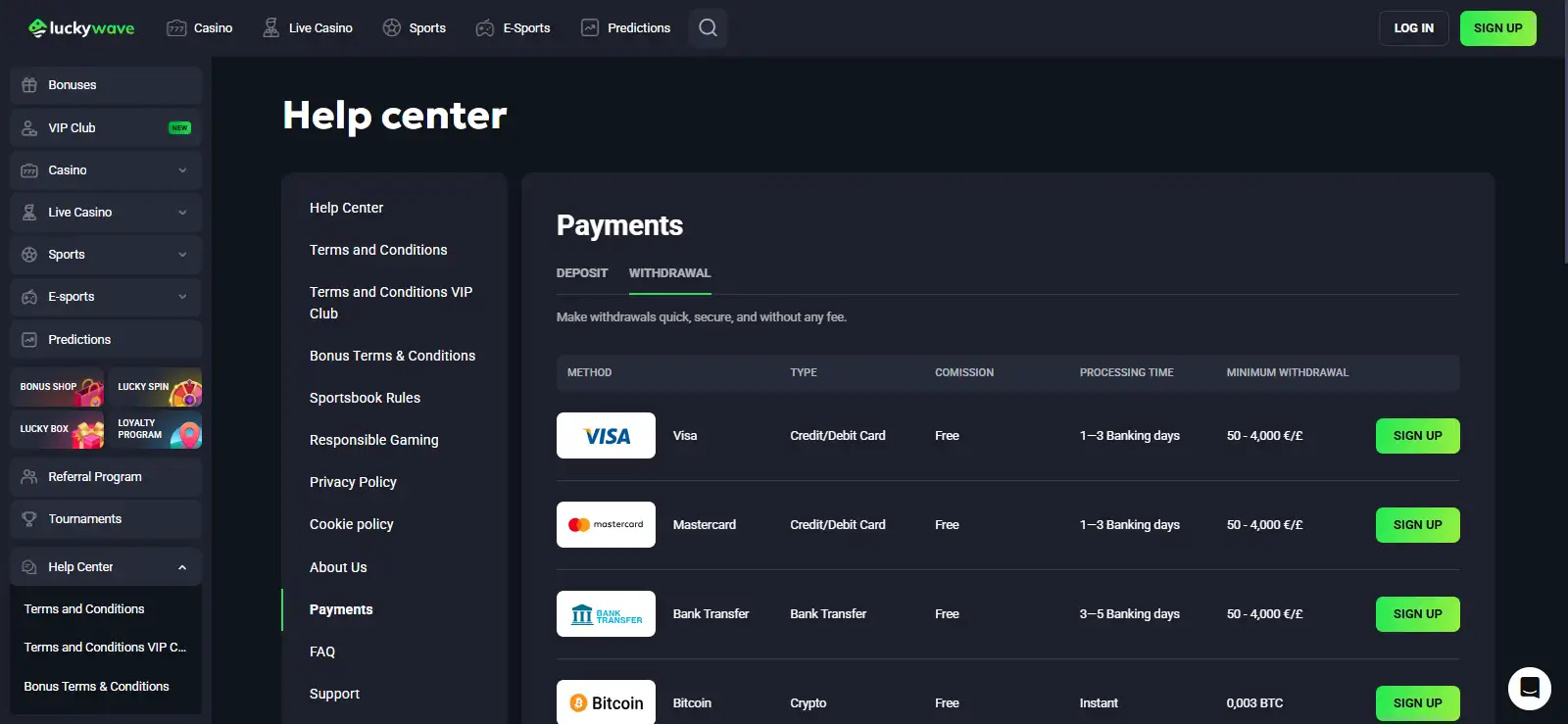
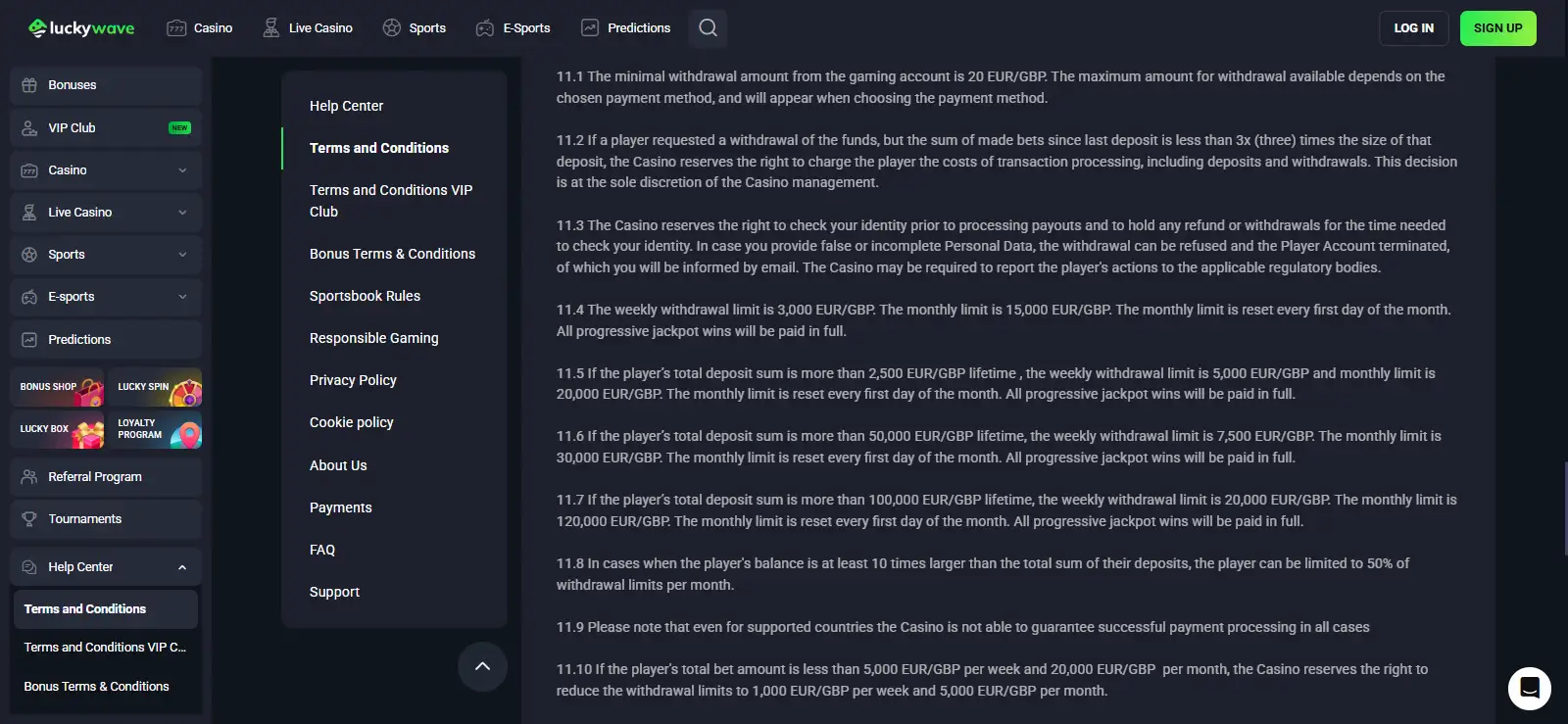
LuckyWave’s official payments page currently publishes method-specific processing times: Visa and Mastercard withdrawals are listed at 1-3 banking days, while bank transfer is listed at 3-5 banking days. Crypto rows are labelled Instant. The general terms also reserve the right to carry out identity and security checks before a payout and to hold a withdrawal while verification is completed. That means a user complaint about elapsed calendar time cannot be cleanly compared with a payment-method row unless the account’s verification status and the stage of processing are known.
The right response is not to dismiss the complaints or to turn them into a universal non-payment claim. Use the LuckyWave withdrawals guide to understand the operator’s published process, then treat a pattern of delay complaints as an additional due-diligence signal showing that some reviewers experienced friction in that process.
Recurring theme 2
Account-closure complaints are particularly relevant when self-exclusion matters to you
Another repeated theme in recent Trustpilot material is frustration about closing an account. Several reviewers describe repeated emails, contact with support or a named account representative while saying the account remained open. One September review complains that a password was deliberately changed and discarded in an attempt to stop access, while an August review describes a prolonged email loop around account closure.
Those are allegations by individual reviewers. They should not be rewritten as a proven policy that LuckyWave refuses every closure request. What can be verified from LuckyWave’s own public material is that the site has a Responsible Gaming page and points users to external help organisations including Gamblers Anonymous, GamCare and Gambling Therapy. The current public material examined for this project does not establish UKGC licensing or verified GAMSTOP participation for LuckyWave.
If self-exclusion reliability is a decisive requirement, verify the exact controls available in the account and the scheme they belong to before funding it. The LuckyWave UKGC and licence status guide explains why a local licence check matters when assessing those protections. The full LuckyWave review places that regulatory question alongside the product evidence.
Recurring theme 3
Support complaints coexist with an official 24/7 support claim
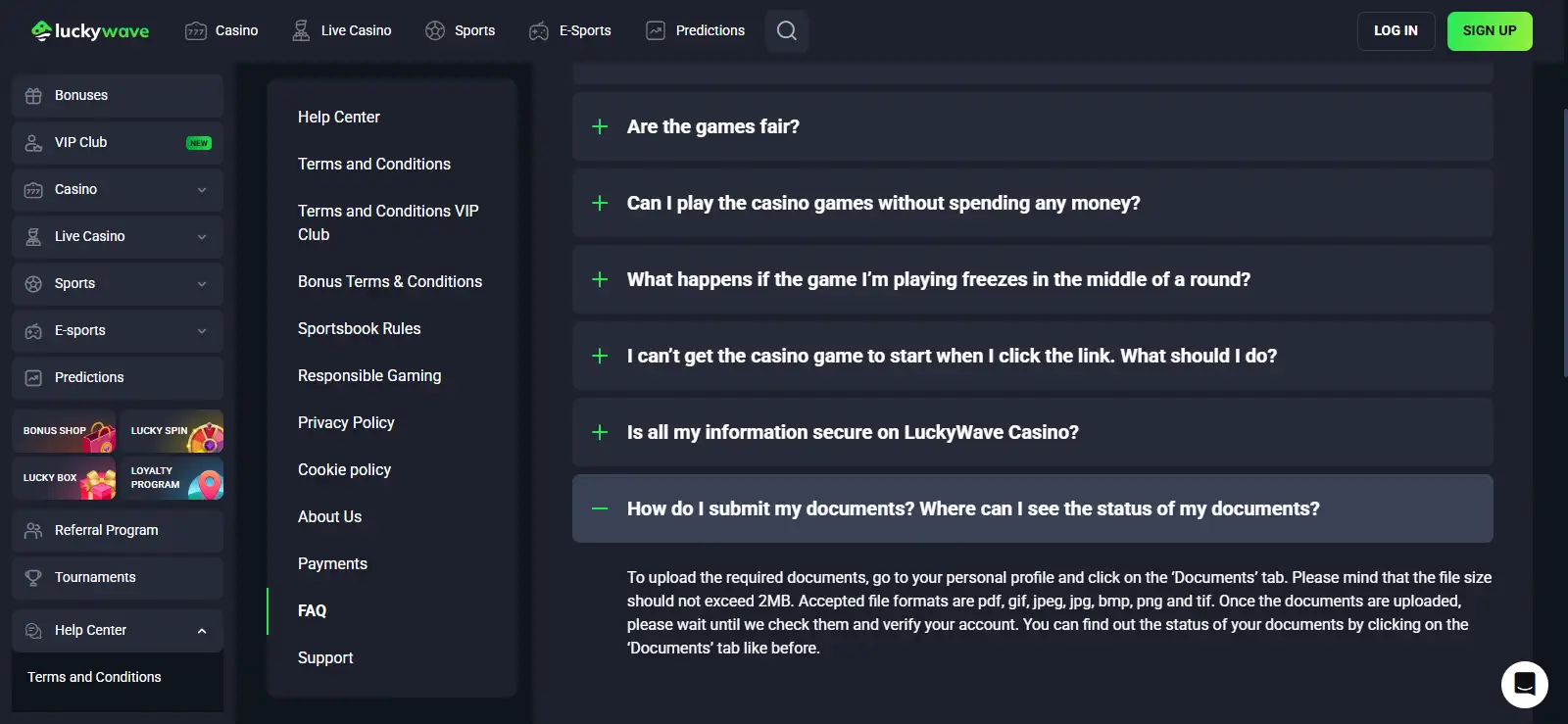
LuckyWave’s official Help Center says customer service is available 24/7 and lists email plus Intercom as contact routes. The dedicated support page likewise advertises 24/7 support. Reviewers, however, frequently judge support on responsiveness and resolution rather than mere availability. Current negative reviews include claims of repetitive replies, unclear withdrawal updates and dissatisfaction with attempts to close accounts.
Both pieces of evidence can be true at the same time: a support channel can be available around the clock while a user remains unhappy with the substance or speed of the answer. That is why this page does not convert “24/7” into “good support”, and it does not convert a poor individual experience into proof that support is always ineffective.
For practical due diligence, save written support exchanges when the issue concerns a withdrawal, identity check or closure request. Dates, requested documents and status messages are more useful than a later recollection of the conversation if you need to compare what happened with the site’s published terms.
Recurring theme 4
Licence concerns in reviews should be verified against the regulator, not repeated as slogans
Some Trustpilot reviewers explicitly raise concerns about LuckyWave not being licensed by the UK Gambling Commission. Because reviewer statements can be inaccurate, the licensing point needs its own primary-source check rather than being accepted from a one-star post.
The separate register check did not verify a UKGC licence for LuckyWave, luckywave.com or the reported operator AMO GLOBAL S.R.L. on 11 September 2026. That independently verified result is the proper basis for the licence discussion. A complaint can alert you to a question; the regulator register should answer it.
Equally, the absence of a verified local licence does not validate every allegation made in the same review. Claims of fraud, theft, rigged games or universal non-payment require their own evidence and are not treated here as established facts.
Evidence ladder
- Regulator register: primary evidence for local licence status.
- Operator terms: primary evidence for published process and rules.
- Aggregate rating: reputation signal.
- Individual review: anecdotal account requiring attribution.
Avoiding cherry-picking
The review profile also contains positive experiences
A fair reputation audit should not select only the strongest one-star accusations. The current Trustpilot distribution shows 38% five-star reviews, and visible positive or mixed reports include users describing successful play or saying that a withdrawal was eventually sorted after support contact. Casino Guru also separates user feedback from its lower Safety Index rather than presenting every customer response as negative.
Positive reviews do not cancel recurring complaint themes, just as negative reviews do not prove a universal outcome. The value comes from pattern recognition: which issues appear repeatedly, whether the operator replies, whether the issue can be compared with a published term and whether an independent primary source can confirm the underlying regulatory claim.
This is especially important for casinos because the emotional extremes of winning, losing and waiting for money naturally produce strongly worded reviews. Treat the review platforms as a source of questions to investigate, not as a substitute for cashier terms, KYC rules or licence registers.
Practical use
How to use LuckyWave reviews before depositing
- Check the current aggregate rating and review count rather than relying on an old saved rating.
- Search recent reviews for the issue that matters to you – withdrawals, verification, support or closure – instead of reading only the most dramatic post.
- Compare the complaint with the relevant official term. A payment delay should be compared with the published method window and any verification hold, not with an unrelated bonus rule.
- Verify regulatory statements independently. The LuckyWave trust and licence page uses the UKGC register rather than reviewer assertions.
- Keep records of your own account state, documents and support messages if you proceed, because an anecdote from another player cannot establish what happened on your account.
For identity checks specifically, the LuckyWave KYC guide covers the documents and upload route the operator currently publishes. That matters because verification can sit between a withdrawal request and the payment method’s normal processing stage.
Reputation decision
What the current LuckyWave complaint pattern should change in your decision
The present reputation picture is not neutral: Trustpilot is at 2.7/5 from 780 reviews, and Casino Guru gives LuckyWave a 2.5/10 Very low Safety Index. Repeated negative themes around withdrawals, support and account closure are therefore worth treating as real due-diligence signals, even though the individual allegations remain anecdotal.
Use those signals alongside, not instead of, the hard evidence. LuckyWave publishes withdrawal windows and 24/7 support, while licensing evidence is handled separately in the trust guide. If predictable local regulatory protection, self-exclusion coverage or low-friction cashout is a priority, that combined evidence should materially raise the threshold you require before depositing.
Written by the editors at LuckyWave Casino.